
Freight on Board (FOB) – Definition & Meaning
Lets define FOB Shipping (FOB), also known as Free on Board, is an international shipping term used to specify the point at which the ownership, risk, and cost of goods shift from the seller to the buyer. It’s commonly used in trade agreements, purchase orders, and bills of lading, particularly in maritime shipping.
Live FOB freight rates can be check by clicking here.
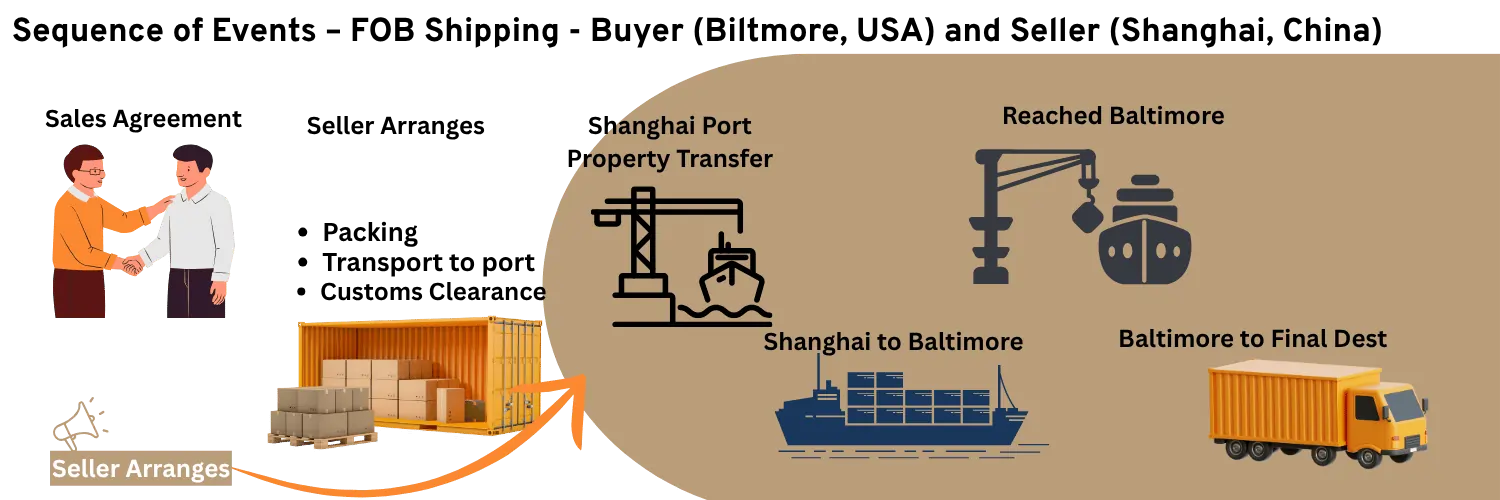
Here’s a clear step-by-step sequence for FOB shipping of a container of electronics from Shanghai, China to Biltmore, USA (FOB Shanghai Port):
Sequence of Events – FOB Shipping (FOB Shanghai Port)
1. Sales Agreement
- Buyer (Biltmore, USA) and Seller (Shanghai, China) sign a sales contract specifying FOB Shanghai Port.
- Contract states that risk and cost transfer from seller to buyer once the goods are loaded on the vessel at Shanghai.
2. Manufacturing & Packing
- Seller manufactures or sources the electronics.
- Goods are packed in cartons and placed into a shipping container according to export packaging standards.
3. Inland Transport to Port
- Seller arranges truck/rail transport from their factory to Shanghai Port container terminal.
- Seller covers these costs under FOB terms.
4. Export Customs Clearance
- Seller prepares commercial invoice, packing list, export license (if required), and other documents.
- Seller completes export customs formalities in China.
5. Loading on Vessel (Risk Transfer Point)
- Seller delivers container to the terminal and ensures it’s loaded onto the buyer’s nominated vessel.
- Once the container is on board the vessel, ownership and risk pass to the buyer.
6. Ocean Freight
- Buyer arranges and pays for the sea freight from Shanghai Port to the USA (e.g., Port of Savannah or Port of Los Angeles, depending on inland route to Biltmore).
- Buyer also arranges marine insurance if desired.
7. Import Customs Clearance in USA
- Buyer prepares import declaration, pays customs duties and taxes.
- Buyer handles compliance with US import regulations (e.g., FCC for electronics).
8. Inland Transport to Biltmore
- Buyer arranges truck or rail transport from the US port to Biltmore.
- Buyer pays all costs for inland transport.
9. Final Delivery
- Container arrives at buyer’s facility in Biltmore.
- Buyer unloads the electronics and returns the empty container to the designated depot.
💡 Key FOB Principle in This Journey:
The seller’s responsibility ends once the container is on board the vessel in Shanghai. The buyer takes over cost and risk from that exact moment.
Under FOB terms, the seller is responsible for all costs, handling, and risks up to the designated FOB point (such as the port of shipment). Once the goods are loaded onto the vessel at that location, the buyer assumes responsibility for:
- Freight charges from the FOB point to the destination.
- Insurance costs during transit (if applicable).
- Risks of loss or damage after loading.
There are two common variations of FOB:
- FOB Origin (Shipping Point) – Ownership and responsibility transfer to the buyer as soon as goods are loaded onto the vessel at the seller’s port.
- FOB Destination – Ownership and responsibility transfer only when the goods arrive at the buyer’s specified location.
Why FOB Matters in International Trade
- Clarifies financial responsibility for freight costs.
- Defines liability in case of loss or damage.
- Avoids disputes in cross-border transactions by setting clear handover terms.
- Used in Incoterms® (International Commercial Terms) by the International Chamber of Commerce (ICC).
Example: 1
If a contract states “FOB Jeddah Port,” the seller covers costs until goods are loaded on the ship in Jeddah. From that moment, the buyer pays all remaining freight, insurance, and customs fees.
Here’s a very simple, beginner-friendly explanation of FOB Shipping, with two clear examples:
FOB Shipping – Simple Definition
FOB Shipping means Free on Board – Shipping Point.
It tells you that the buyer becomes the owner of the goods as soon as the seller ships them from their location.
From that moment:
- The buyer pays for shipping.
- The buyer is responsible if anything gets damaged or lost during transport.
Example 1 – Export from Pakistan to UAE
A textile company in Karachi sells fabric to a buyer in Dubai, with terms FOB Karachi Port.
- Seller: Delivers fabric to Karachi Port and loads it on the ship.
- Buyer: Pays for ocean freight from Karachi to Dubai and takes the risk once goods are on the ship.
Example 2 – Local Delivery Inside Saudi Arabia
A company in Riyadh sells spare parts to Jeddah with terms FOB Riyadh Warehouse.
- Seller: Loads goods onto the truck at Riyadh warehouse.
- Buyer: Pays the trucking cost from Riyadh to Jeddah and is responsible for any damage during transit.
💡 In short: Under FOB Shipping, the seller’s job ends when goods are shipped; the buyer takes over costs and risks from that point.
Comments